


Cooling accounts for roughly 40 percent of total energy consumption in the average data center, according to the U.S. Department of Energy. That figure surprises most facility managers, who focus their efficiency efforts on server hardware and power infrastructure while overlooking one of the most persistent sources of thermal load in their building: the glass.
Windows and glazed walls admit solar heat continuously during daylight hours. In a facility where every degree of temperature deviation matters, that unmanaged heat gain forces cooling systems to compensate constantly, driving up energy costs and accelerating equipment wear.
Solar control window film is a retrofit solution that addresses this problem directly. It requires no structural changes, no downtime, and no new equipment. It simply makes your existing glass work for your facility instead of against it.
Most data center energy audits focus on server density, power draw, and cooling infrastructure. Glass is rarely included in the thermal analysis, yet it is one of the most consistent sources of unmanaged heat gain in any building with exterior windows. This section explains why.
Standard commercial glass transmits a significant portion of solar radiation, including both visible light and invisible infrared energy. That infrared energy converts to heat the moment it enters the room, creating localized temperature spikes near perimeter walls and windows.
Server rooms and data centers are precision thermal environments. A hot spot near a window-facing rack can push equipment beyond its rated operating temperature, triggering thermal throttling, reducing processing capacity, and shortening component lifespan. Even a few degrees of unmanaged heat near critical hardware represents a measurable uptime risk.
Cooling systems are designed to maintain a target temperature range across the entire facility. When windows allow solar heat to concentrate in specific zones, the HVAC system must work harder to bring those areas back into range.
This continuous compensation cycle increases energy consumption, accelerates compressor wear, and raises maintenance frequency. Over the course of a year, the cumulative energy cost of solar heat gain through unprotected glass is substantial, yet it is rarely itemized or analyzed in standard energy audits.
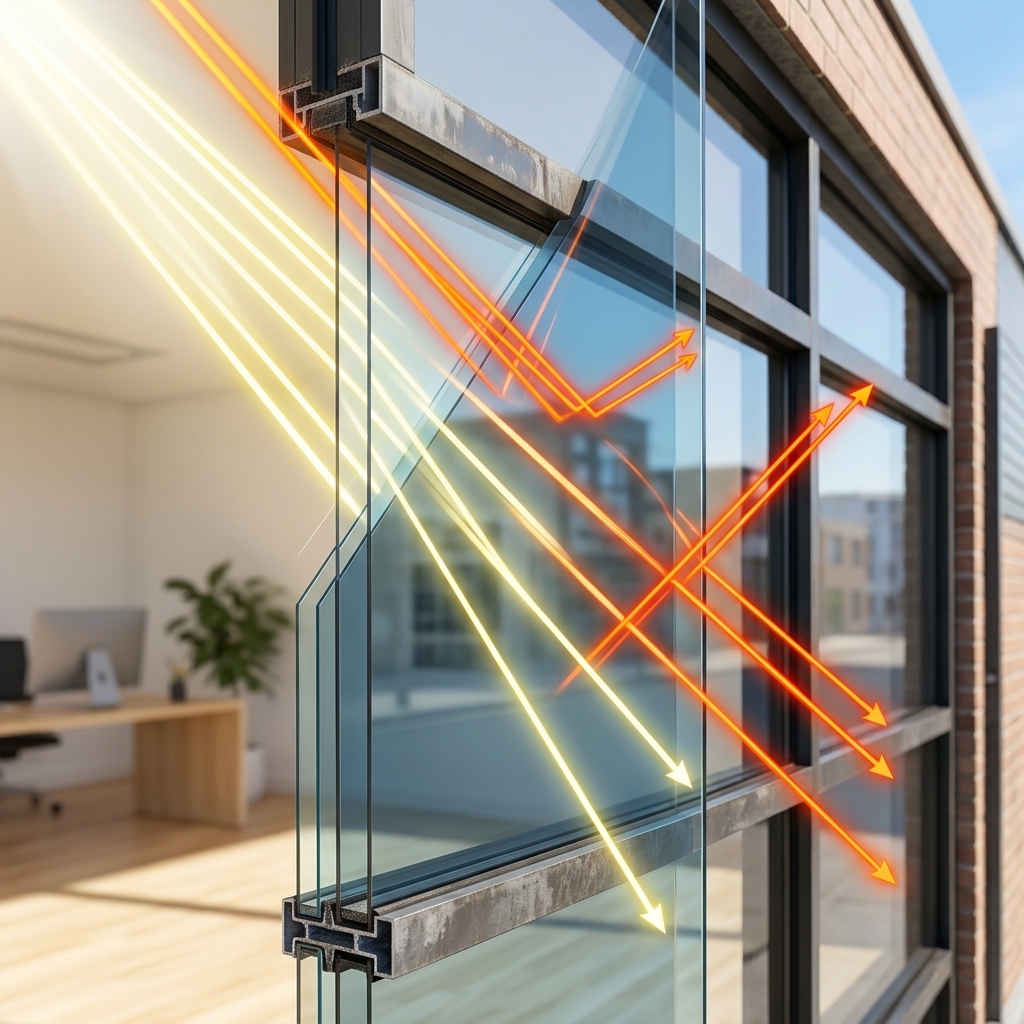
Solar control window film is a thin, multi-layer polyester film applied to the interior surface of existing glass. It intercepts solar energy before it enters the room, dramatically reducing the thermal load your facility's cooling systems must manage. Understanding two key concepts helps explain why it works so well.
The Solar Heat Gain Coefficient, or SHGC, is the primary metric for evaluating window film performance. It measures the fraction of solar radiation that passes through a window, expressed as a number between 0 and 1.
Standard commercial glass typically carries an SHGC of 0.6 to 0.8, meaning 60 to 80 percent of incident solar energy enters the room as heat. High-performance solar control films can reduce this to 0.2 to 0.35, cutting solar heat transmission by more than half without replacing the glass itself.
Solar radiation consists of three components: visible light, ultraviolet radiation, and infrared radiation. Infrared radiation is the primary driver of heat gain, accounting for roughly 53 percent of total solar energy.
Infrared rejection films use advanced metallic or ceramic coatings to reflect and absorb this heat-producing wavelength before it passes through the glass. The result is a window that looks virtually unchanged from the inside but transmits a fraction of its previous heat load, stabilizing interior temperatures across the entire perimeter of the facility.
Solar control window film intercepts infrared heat at the glass surface, blocking it before it enters the room.
Not all solar control films perform the same way. Selecting the right film type depends on your facility's priorities: maximum heat rejection, visual transparency, or a balance of both. The two main categories for commercial data center applications are reflective films and spectrally selective or ceramic films.
Reflective films use metallic coatings to bounce solar energy away from the glass surface before it can be transmitted as heat. They achieve some of the highest heat rejection ratings available, often blocking 70 to 80 percent of total solar energy.
The tradeoff is visible reflectivity. Reflective films give glass a mirrored appearance from the outside. This is entirely suitable for perimeter server rooms and utility areas, but less ideal for glass-walled command or monitoring areas where exterior visibility and natural aesthetics matter.
Spectrally selective and ceramic films are engineered to target heat-producing infrared wavelengths specifically, while allowing higher levels of visible light to pass through. They achieve high heat rejection without the mirror-like appearance of metallic films.
This makes them the preferred choice for command centers, monitoring stations, and any glazed area where both thermal performance and visual clarity are priorities. Ceramic films use nano-particle technology that delivers exceptional infrared rejection with no signal interference, which is a critical advantage in RF-sensitive data center environments.
Facilities rarely self-diagnose this problem clearly. If your facility exhibits any of the following conditions, solar heat gain through glass is likely a contributing factor:
These are not random inefficiencies. They are measurable symptoms of unmanaged solar heat gain, and each one has a direct fix.
Unprotected windows create localized heat zones that force cooling systems to overcompensate, raising energy costs and equipment risk.
The financial case for solar control window film is straightforward. Reducing solar heat gain reduces the work your cooling system must perform. Less cooling work means lower energy consumption, lower maintenance costs, and longer equipment lifespans. Two metrics frame this return most clearly for data center operators.
Power Usage Effectiveness, or PUE, is the industry-standard metric for data center energy efficiency. A PUE of 1.0 is perfect efficiency, where every watt drawn by the facility goes directly to IT equipment. A PUE of 2.0 means half of all facility power goes to overhead, primarily cooling.
The global average PUE is approximately 1.58 according to the Uptime Institute's annual survey. Solar control window film directly reduces the heat load that cooling systems must manage, lowering the energy required for thermal regulation and improving the facility's PUE. Even a modest improvement in PUE translates to significant annual savings at scale.
Traditional responses to heat management problems in data centers involve HVAC capacity upgrades, precision air conditioning units, or hot-aisle and cold-aisle containment systems. These are high-capital projects that require planning, procurement, and often structural work.
Solar control window film is a fraction of the cost. Professional installation for a mid-sized commercial facility typically ranges from $8,000 to $25,000 depending on glazing area, compared to $50,000 to $500,000 for HVAC infrastructure upgrades. Most facilities recover the film investment through energy savings within two to four years, with the film continuing to perform for 10 to 15 years beyond that.
Solar control film's primary value in a data center context is thermal management. The secondary benefits strengthen the business case considerably and address concerns that facilities directors frequently raise independently.
These benefits compound the energy savings case, making window film one of the highest-value facility upgrades available on a cost-per-benefit basis. For a broader view of how commercial window film delivers operational and safety value, read Benefits of Commercial Window Film: Energy Savings and Safety.
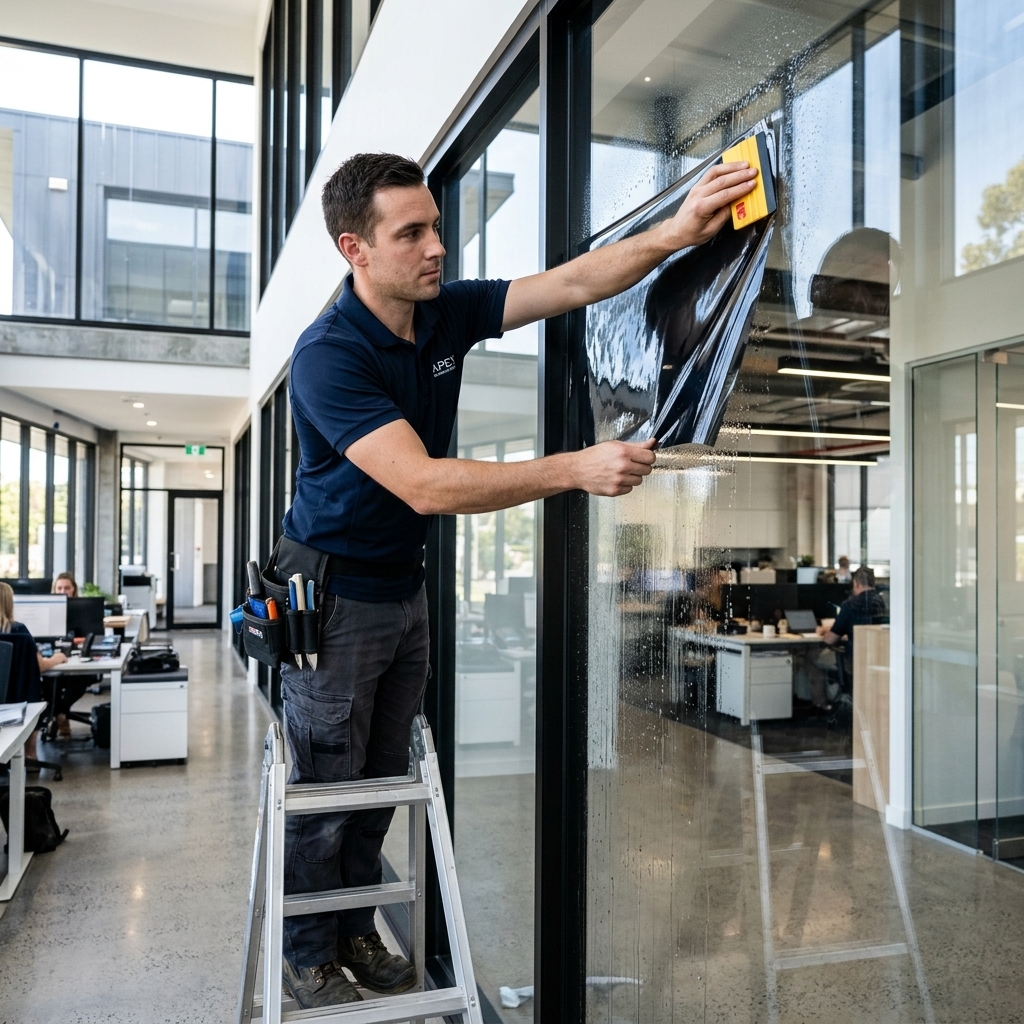
One of the most common objections from data center operators considering window film is concern about installation disruption. Professional commercial window film installation requires no downtime, no server shutdowns, and no changes to network or power infrastructure.
Installation is performed entirely from the interior of the building. Technicians clean the glass surface, apply the film using a water-based solution, and complete the process with edge sealing. The work produces no dust, no vibration, no chemical fumes, and no interference with equipment or network operations.
For perimeter windows in live server environments, installation crews typically work section by section to minimize temporary access restrictions. Most mid-sized facilities are fully completed within one to two business days. For larger commercial facilities, the timeline and approach should be confirmed with your provider during the site assessment.
For context on what compliant commercial window film installation looks like in practice, Window Films Offer Measurable Green Building Benefits provides a useful overview of what to expect from a professionally executed project.
Professional installation is completed from the interior surface with no disruption to server operations, power infrastructure, or network equipment.
Yes, measurably so. Solar control window film reduces solar heat entering through glass by 50 to 80 percent depending on the film selected. In rooms with significant glazing exposure, this can reduce ambient temperature near perimeter walls by 5 to 15 degrees Fahrenheit during peak solar hours.
The effect is most pronounced in rooms with south or west-facing windows, where direct sun exposure is longest. Facilities that have deployed infrared rejection film consistently report stabilized temperature readings near perimeter racks within the first weeks after installation.
No. Professional installation is a clean, interior-only process. There is no dust, vibration, chemical fume exposure, or physical disruption to equipment, cables, or cooling infrastructure during the work.
The only access requirement is a clear working zone immediately adjacent to the windows being treated. In live server environments, this is typically a small perimeter buffer that can be maintained without affecting rack access, network operations, or HVAC function.
For data center and server room applications, target a film with an SHGC of 0.25 or below. This represents a rejection of 75 percent or more of total solar heat, which is sufficient to produce a measurable reduction in perimeter thermal load in most commercial facility configurations.
If your facility has south or west-facing glazing with long daily sun exposure, discuss spectrally selective films with your installer. These deliver high heat rejection with minimal visual impact, which is valuable in mixed-use facilities where monitoring stations share perimeter wall exposure with server infrastructure.
Yes. Window film contributes to LEED certification credits in the Energy and Atmosphere category by reducing the energy demand of mechanical cooling systems. It can also contribute to the Innovation in Design category when documented as part of a broader building envelope optimization project.
Facilities pursuing ISO 50001 energy management certification or internal ESG carbon reduction targets will find solar control window film one of the fastest-to-implement, lowest-disruption interventions available. Unlike HVAC upgrades, it requires no permit in most jurisdictions and produces measurable, auditable energy reductions from day one of installation. For a full picture of how window film supports green building compliance, see Window Films Offer Measurable Green Building Benefits.
Data centers are among the most energy-intensive facilities in commercial real estate. Cooling is the single largest overhead cost, and solar heat gain through glass is one of the most consistently overlooked contributors to that cost.
Solar control window film is a proven, non-disruptive, and high-ROI solution. It reduces heat at the source, stabilizes perimeter temperatures, lowers PUE, and supports green building compliance without replacing glass, upgrading infrastructure, or disrupting operations.
The payback period is measured in years, not decades. The film continues to perform for over a decade after that.
Contact American Window Film today to schedule a free commercial site assessment. Our specialists will evaluate your facility's glazing exposure, recommend the right film specification, and provide a detailed energy savings estimate tailored to your building.


No Comments Yet
Let us know what you think