

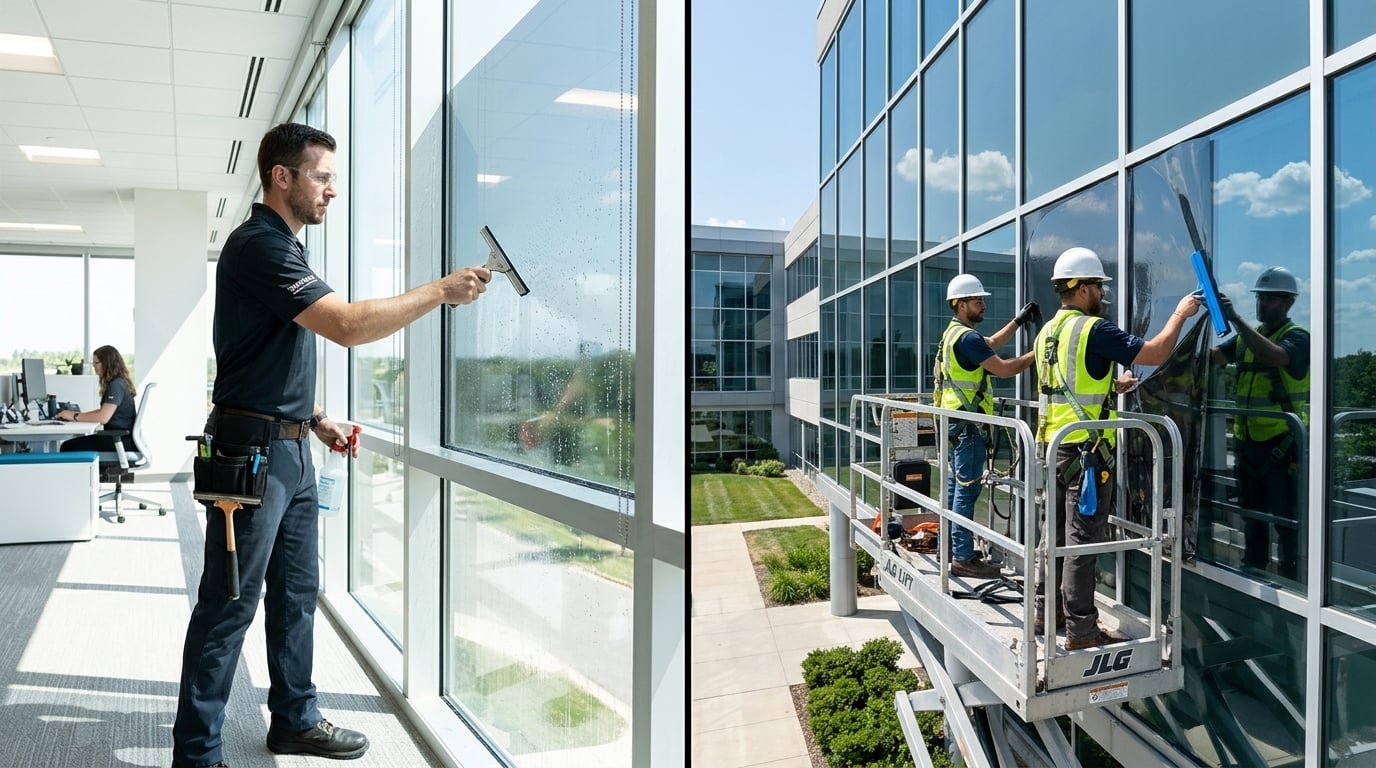
Architects, facility managers, and homeowners planning a flat-glass retrofit often assume all architectural window films mount strictly on the indoor side of a window. While interior installation remains the industry standard for most residential and commercial glass, specifying the wrong side of the pane on complex insulated glazing can sacrifice heat rejection or trigger costly thermal glass breakage.
Modern architectural film chemistry gives building specifiers two distinct engineering options: interior-applied films and weather-hardened exterior-applied films. Understanding the physics, security mechanics, access trade-offs, and warranty differences between interior vs exterior window film ensures every pane in your building performs safely for decades.
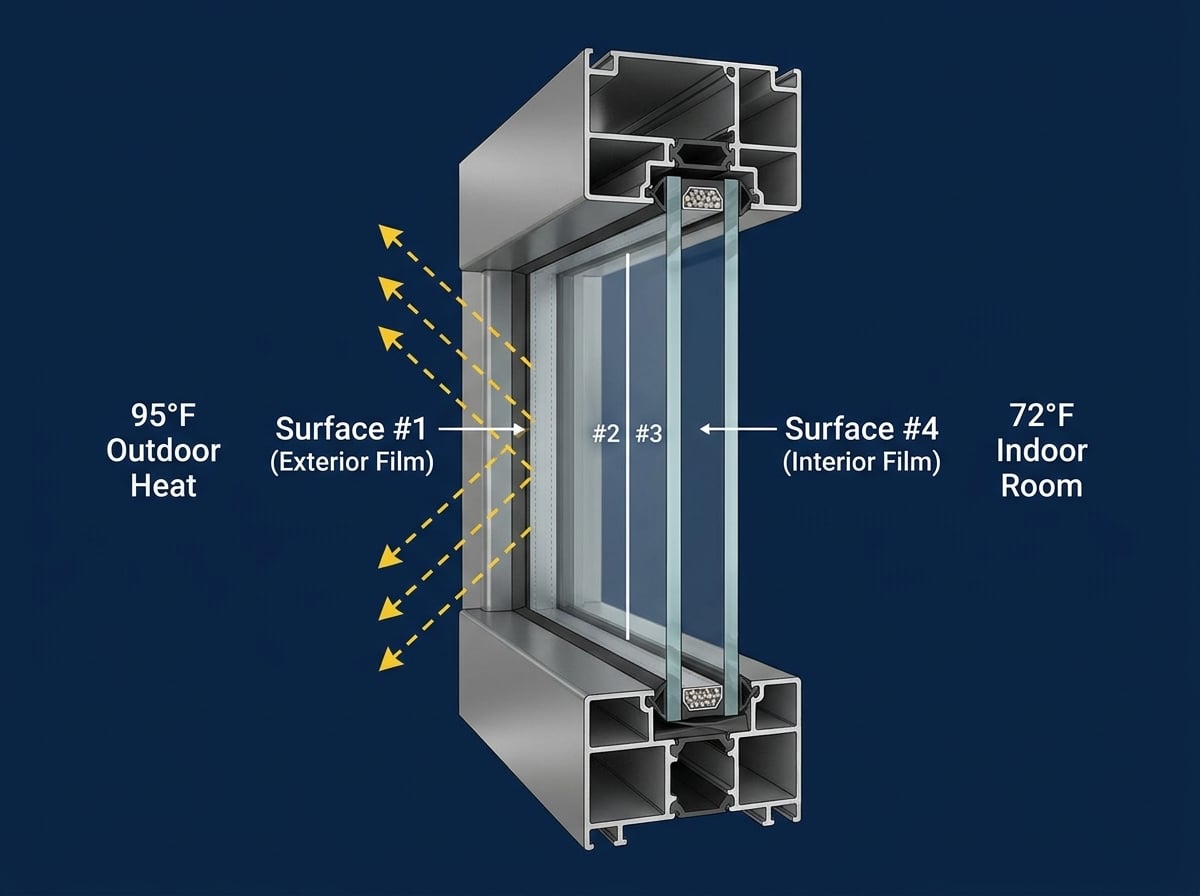
In commercial glazing and architectural specification documents, engineers never refer vaguely to the "inside" or "outside" of a window assembly. Instead, the flat-glass industry numbers every glass face sequentially starting from the outdoors and moving inward toward the conditioned room.
On a single-pane monolithic window, Surface #1 faces the outdoor weather and Surface #2 faces the interior room. On a standard double-pane Insulated Glass Unit (IGU), Surface #1 is the outdoor-facing exterior glass face, Surface #2 and Surface #3 sit sealed inside the argon-filled or air-filled spacer cavity, and Surface #4 faces the building interior.
Factory Low-E metallic coatings are almost always deposited inside the sealed cavity on Surface #2 or Surface #3 during window manufacturing. Because retrofit installers cannot open a sealed double-pane unit, architectural window film must mount either on Surface #1 (exterior window film application) or on Surface #4 (interior window film application), as detailed in our guide to window film for double-pane and single-pane windows.
Whenever existing glass compatibility and indoor room access allow it, certified installers specify interior-applied window film as the first-choice baseline. Mounting film on the room-facing glass surface shields the polyester laminate entirely from UV weathering, windborne grit, acid rain, hail, and harsh exterior window-washing chemicals.
Working indoors also eliminates the expense of boom lifts, suspended swing stages, sidewalk permits, and wind-delay scheduling on upper building floors. Protected inside a climate-controlled 72°F building envelope, quality interior architectural films routinely perform for 15 to 25+ years with minimal maintenance.
Evaluating interior vs exterior window film requires balancing raw thermodynamic performance against outdoor environmental exposure and installation logistics. Neither option is universally superior across every building; each solves specific glazing and operational constraints.
The engineering table below compares interior-applied and exterior-applied flat-glass films across seven critical specification benchmarks.
| Specification Criterion | Interior Window Film (Surface #2 or #4) | Exterior Window Film (Surface #1) |
|---|---|---|
| Solar Heat Rejection Efficiency | High (solar energy passes through glass before hitting film) | Maximum (rejects solar heat on Surface #1 before entering glass) |
| Thermal Stress Glass Safety | Requires NFRC check on tinted, triple-pane, or Low-E IGUs | Safest choice; keeps inner glass panes cool and stress-free |
| Forced-Entry Security Rating | Superior (anchored film catches shattered glass pushed inward) | Secondary only (suited for spall control or anti-graffiti shield) |
| Expected Service Lifespan | 15 to 25+ years indoors away from weather elements | 7 to 12 years vertical glass; 3 to 7 years sloped skylights |
| Perimeter Edge Sealing | Not required for standard solar film (daylight gap standard) | Mandatory 4-sided neutral-cure silicone edge seal required |
| Installation Logistics & Disruption | Low equipment cost; requires technician access inside rooms | Zero indoor tenant disruption; requires lifts or swing stages |
| Manufacturer Commercial Warranty | 10 to 15 years commercial; limited lifetime residential | Up to 7 to 10 years vertical; 5 years sloped applications |
Although interior film handles roughly 80 percent of standard flat-glass installations, modern commercial curtain walls and specialty residential skylights frequently present thermodynamic or physical barriers inside the room. In those exact scenarios, specifying weatherable exterior window film solves problems that interior film simply cannot touch.
When a solar film is installed on the interior side (Surface #4) of a double-pane or triple-pane window, incoming sunlight travels through both panes of glass before striking the film. Any solar energy absorbed by that interior film heats up the inner pane and traps radiant warmth inside the sealed air space, while the shaded perimeter edge of the glass tucked inside the metal mullion stays much cooler.
On bronze-tinted glass, thick laminated IGUs, wire glass, or double-pane units with Surface #3 Low-E coatings, excessive heat buildup on Surface #4 can create uneven thermal expansion that cracks the glass. Installing exterior solar film on Surface #1 reflects and dissipates solar energy into the outdoor breeze before radiation ever touches the glass assembly, eliminating thermal breakage risk completely.
From a pure building-physics standpoint, stopping solar radiation on the exterior face of a window is always more efficient than trying to reject heat after it has already penetrated the glazing envelope. Once infrared solar energy warms an interior glass pane, a portion of that absorbed heat inevitably radiates and convects inward into the conditioned room.
High-performance exterior films like 3M Sun Control Prestige Exterior Series (PR40EX, PR70EX, PR90EX) and exterior reflective silver films reject up to 79 to 86 percent of total solar energy right on Surface #1. When a commercial tower or sun-baked west-facing atrium in a 100°F climate needs every possible BTU of heat rejection to relieve overloaded chillers, exterior solar film delivers peak thermodynamic performance.
Many commercial and institutional buildings contain glass zones where technicians physically cannot reach the interior glass surface without dismantling part of the building. Exterior window film is the go-to engineering solution whenever indoor access is blocked or restricted:
Property owners researching forced-entry protection frequently search whether safety and security window film belongs on the inside or outside of glass doors and storefronts. Unlike solar control where exterior film occasionally wins on heat physics, physical intrusion defense heavily favors interior installation.
Think about the direction of force when a burglar strikes a storefront window with a crowbar or when an explosive shockwave hits a building facade from the street. External impact shatters the glass pane and drives thousands of broken shards inward toward the interior room.
When heavy-duty 8-mil or micro-layered commercial security window film is mounted on the interior glass surface and structurally anchored to the interior window frame with Dow 995 wet-glaze silicone, the film acts like an indoor catcher's mitt. Every inward blow pushes the broken glass web directly against the tear-resistant interior membrane and frame mullions, preventing intruders from peeling the film edges from outside and keeping lethal glass spall out of occupied rooms.
There are two specialized protective cases where installers deliberately mount thick protective film on Surface #1 outdoors rather than indoors:
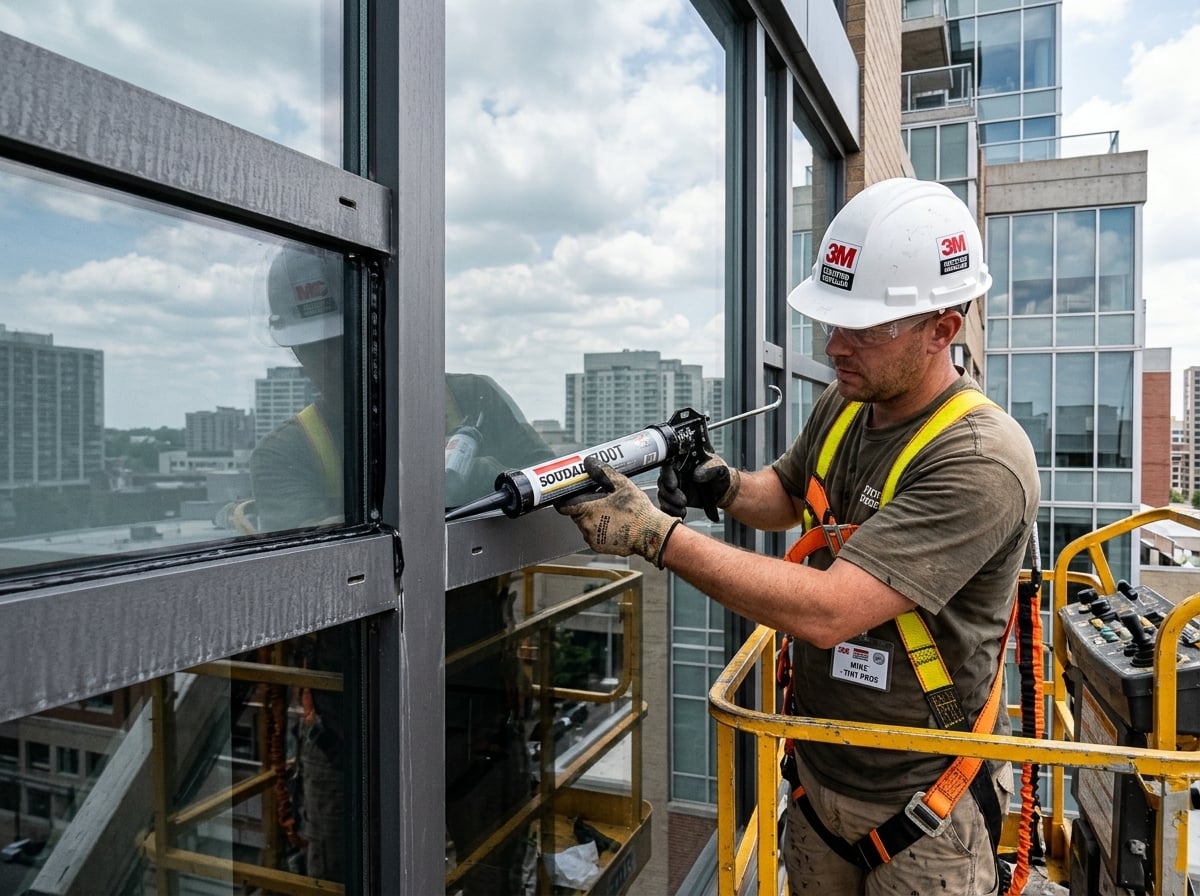
You can never take a roll of standard interior window film and mount it on the outside of a building. Standard interior polyester lacks outdoor UV inhibitors and moisture-resistant adhesives, causing it to delaminate, turn hazy, and peel off in sheets within months of outdoor exposure.
True exterior-grade architectural window films require four specialized product and installation protocols to survive harsh outdoor weather between freezing 10°F winters and scorching 105°F summers:
Setting accurate lifecycle expectations helps commercial asset managers budget long-term capital reserves properly when choosing between interior and exterior glazing retrofits. Because interior window film lives indoors away from direct ultraviolet bombardment and precipitation, manufacturers back commercial interior installations with 10-year to 15-year warranties and residential installations with limited lifetime coverage.
Exterior architectural window films face relentless daily UV radiation, thermal cycling, windblown sand, and pollutants, so manufacturer commercial warranties typically run 7 to 10 years on vertical windows (and 5 years on sloped skylights angled more than 15 degrees from vertical). Choosing non-metalized exterior films like 3M Prestige Exterior and maintaining intact silicone edge seals maximizes clarity through the full warranty term and beyond.
Facility window-washing vendors must also follow soft-wash exterior maintenance rules once Surface #1 is filmed. Cleaners should use soft rubber squeegees, microfiber washers, and neutral pH ammonia-free solutions while strictly banning razor scraper blades, steel wool, abrasive bristle brushes, and high-pressure power washers near sealed perimeter edges.
Architects, building engineers, and homeowners comparing glazing proposals often raise practical questions about durability, performance, and glass safety. Here are direct answers from certified specification specialists.
Yes, comparing equivalent film technologies on the exact same double-pane window, an exterior-applied solar film blocks roughly 10 to 20 percent more total solar heat than its interior counterpart. Because exterior film intercepts and reflects solar infrared energy on Surface #1 before it enters the outer glass pane, almost zero absorbed solar heat radiates inward into the room.
Never install an interior-rated window film on an exterior glass surface. Interior adhesives and standard scratch coatings break down rapidly when exposed to rain, dew, freezing temperatures, and unattenuated solar UV rays, voiding all manufacturer warranties immediately.
High-grade commercial exterior solar films engineered by leading manufacturers like 3M and HanitaTek typically last 7 to 12 years on vertical architectural glass when properly edge-sealed with neutral-cure silicone. Sloped overhead skylights receive far more intense direct sun and standing water, resulting in a typical service life of 4 to 7 years before scheduled re-filming.
Forced-entry and blast-mitigation security window film is almost always installed on the interior surface of the glass and anchored to the interior window frame. Interior placement forces shattered glass to push inward against the tear-resistant film and structural silicone anchor, whereas exterior placement is reserved mainly for sacrificial anti-graffiti protection.
Choosing between interior and exterior window film is never guesswork when backed by NFRC thermal stress modeling and hands-on site inspection. Whether your property calls for long-lasting interior ceramic solar film, anchored interior 3M Scotchshield Ultra security film, or high-rejection exterior solar film on hard-to-reach curtain walls and skylights, matching the film to the exact glass surface protects both your windows and your budget.
As one of the nation's premier authorized commercial and residential window film contractors, our OSHA-certified technicians handle everything from indoor occupied-office installations to multi-story exterior swing-stage retrofits with full manufacturer warranty backing. To schedule a glass compatibility check and custom specification quote for your home or commercial facility, contact the team at American Window Film.
No Comments Yet
Let us know what you think