

Commercial real estate portfolios across the United States face a fundamental regulatory shift as municipal carbon caps take effect. Municipalities are actively enforcing strict Building Energy Performance Standards (BEPS) to curb greenhouse gas emissions from the built environment.
Property owners who fail to reduce their operational energy consumption now face substantial annual financial penalties. Facility executives must implement rapid, high-impact decarbonization strategies that deliver verified energy reductions without draining capital reserves.
Urban climate legislation has shifted commercial property management from voluntary sustainability benchmarking to mandatory emissions compliance.
Regulations such as New York City's Local Law 97, Boston's BERDO 2.0, Washington D.C.'s BEPS, and Denver's Energize Denver establish declining carbon caps per square foot. Under New York City Local Law 97, buildings exceeding 25,000 square feet face fines of $268 for every metric ton of carbon dioxide equivalent over their prescribed limit.
These regulatory thresholds tighten aggressively through 2030 and 2035. Commercial office towers, healthcare facilities, and multi-family residential complexes risk hundreds of thousands of dollars in recurring municipal penalties if energy intensity is not addressed immediately.
Operational carbon emissions stem directly from fossil fuel combustion and grid electricity consumption. Because cooling and heating account for the majority of commercial utility consumption, building envelope performance has become the central focus of facility engineering teams.
Meeting these stringent benchmarks requires asset managers to evaluate every square foot of their building envelope. Inefficient glass facades represent the single largest operational vulnerability in existing commercial structures.
While facility engineers frequently invest in LED lighting upgrades and variable frequency drives, uninsulated glass facades remain the primary driver of excessive HVAC energy consumption.
Glazing systems dictate how much radiant heat enters an interior space during summer and how much thermal heat escapes during winter. Untreated commercial windows force mechanical chillers and boilers to work continuously to balance severe perimeter thermal swings.
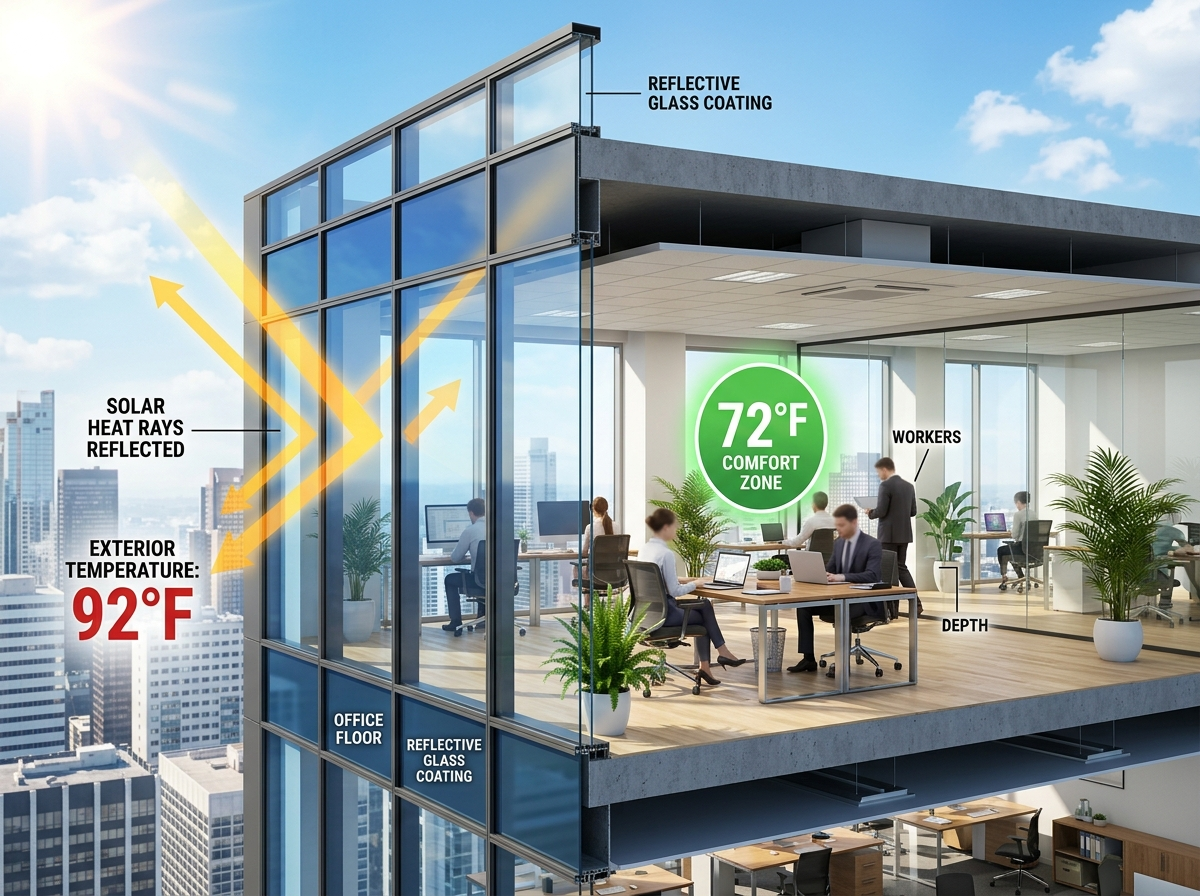
Solar radiation passes effortlessly through standard clear or lightly tinted commercial glass. This incoming infrared energy transforms into radiant heat once inside, creating severe localized hot spots throughout south-facing and west-facing building elevations.
Perimeter office temperatures can surge above 85°F even while central core zones remain uncomfortably cold. Central chilled water plants must operate at peak capacity for hours just to counter this continuous solar radiation.
According to building envelope energy audits, solar heat gain through inefficient windows accounts for up to 30% of total commercial cooling loads. Eliminating this uncontrolled thermal influx is essential to achieving mandatory emissions reductions under local energy laws.
Standard commercial double-pane windows possess relatively poor thermal insulation values compared to insulated spandrel panels or opaque walls. During cold winter months, interior radiant heat transfers outward through cold glass panes at an accelerated rate.
Perimeter heating systems must run constantly to counteract cold downdrafts dropping off large glass surfaces. This heat loss drives up natural gas or steam consumption, directly increasing a property's reported operational carbon footprint.
Upgrading glazing thermal resistance stabilizes perimeter temperatures and reduces baseline boiler operation. Maintaining consistent perimeter insulation values prevents energy waste across all four seasons.
Commercial utility billing structures heavily penalize properties for peak electrical demand kilowatts during the hottest hours of the day. When afternoon sun strikes unshaded glass facades, HVAC chillers surge to maximum output to prevent indoor temperatures from climbing past setpoints.
These simultaneous mechanical spikes trigger massive demand ratchet charges that inflate utility bills for months. High peak electricity draw also strains the municipal electrical grid, prompting utilities to levy heavy grid-reliability surcharges on commercial accounts.
Controlling solar heat penetration flattens midday cooling curves and prevents expensive peak demand spikes. A stabilized thermal envelope allows facility managers to avoid punitive time-of-use electrical rates.
Decarbonization engineering experts strongly recommend an envelope-first approach prior to undertaking major mechanical plant overhauls.
Addressing the building envelope first permanently lowers the peak thermal load of the entire structure. When engineers calculate heating and cooling loads for new electric heat pump or VRF installations, a fortified envelope allows them to specify significantly smaller mechanical equipment.
Installing high-efficiency HVAC equipment on a thermally weak building results in oversized chillers running at inefficient partial loads. Oversized equipment increases upfront capital costs, wastes valuable mechanical room space, and consumes excess electricity during startup cycles.
By retrofitting existing commercial windows first, building operators reduce total required HVAC tonnage by 15% to 25%. This permanent load reduction protects property owners from overpaying for mechanical equipment while accelerating building decarbonization timelines.
Integrating energy saving window films for office buildings establishes an immediate baseline reduction in annual energy usage intensity (EUI). Lowering overall EUI helps properties maintain compliant emissions ratings year after year.
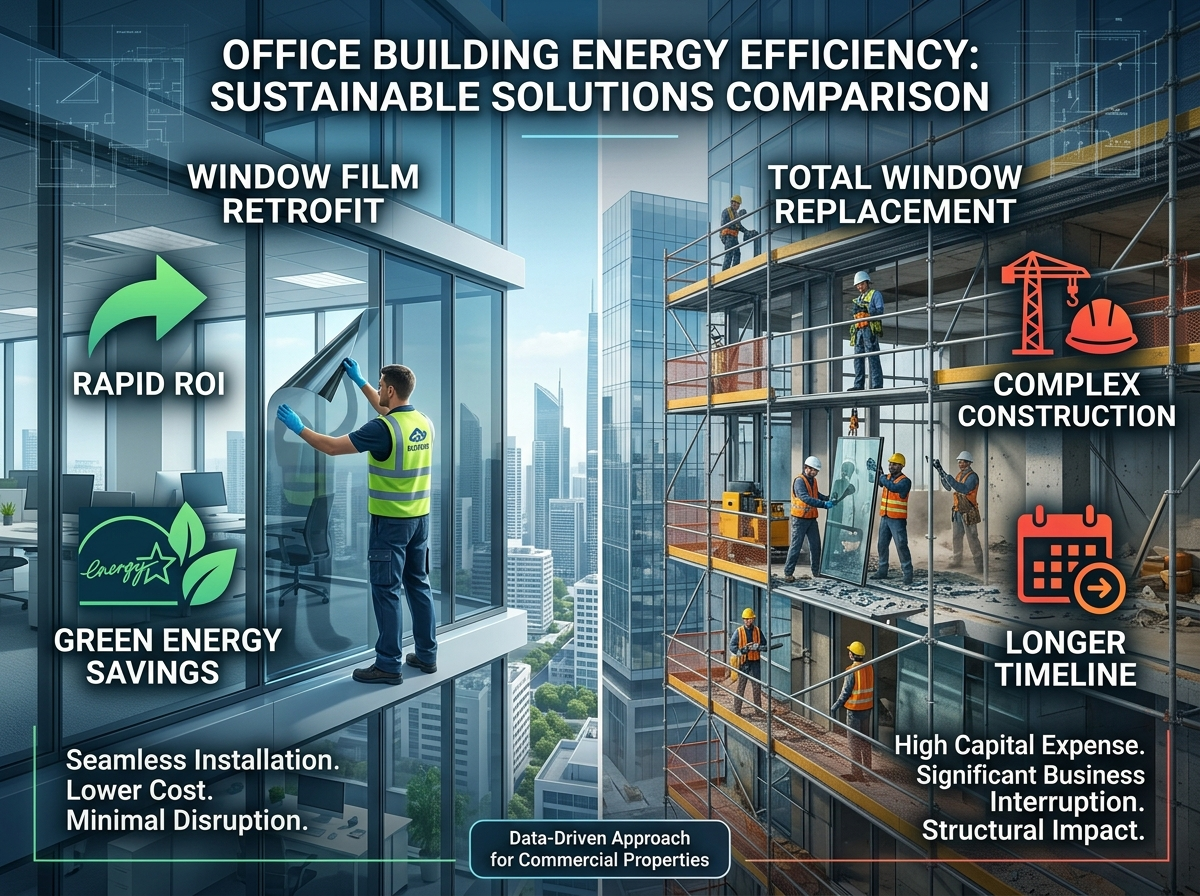
Commercial real estate executives often assume that upgrading facade thermal performance requires complete window replacement.
However, total window glazing replacement involves astronomical capital costs, prolonged lead times, structural engineering reviews, and severe tenant disruption. In contrast, applying high-performance architectural solar control and insulating window film upgrades existing glass at a fraction of the cost.
| Evaluation Criteria | Architectural Window Film Retrofit | Full Commercial Window Replacement |
|---|---|---|
| Average Cost Per Square Foot | $8 to $16 installed | $100 to $250+ installed |
| Installation Timeline | Days to weeks | 6 to 24 months |
| Tenant Disruption | Zero downtime; installed in occupied spaces or off-hours | High disruption; scaffolding, noise, perimeter office vacating |
| Embodied Carbon Footprint | Negligible; preserves existing frames and glass panes | Massive; heavy manufacturing, transport, and landfill waste |
| Typical ROI Payback Period | 2 to 4 years | 20 to 35+ years |
Window retrofits allow asset managers to deploy capital efficiently across their entire property portfolio. Preserving existing glazing frames also eliminates the embodied carbon emissions associated with manufacturing new aluminum extrusions and structural glass.
By choosing non-invasive retrofits, properties can achieve immediate energy compliance before municipal penalty deadlines arrive.
Modern architectural window films use advanced nanotechnology and spectrally selective coatings to alter the solar optical properties of commercial glass.
Applying these microscopic ceramic or metallic layers to existing vision glass produces dramatic thermal improvements without altering exterior architectural aesthetics. Properties achieve measurable green building benefits that satisfy strict municipal performance standards.
The Solar Heat Gain Coefficient (SHGC) measures the fraction of incident solar radiation admitted through a window, expressed as a number between 0 and 1. Standard monolithic or clear double-pane commercial glass typically exhibits a poor SHGC rating between 0.65 and 0.75.
Advanced solar control window films reduce glazing SHGC to between 0.25 and 0.35. This dramatic drop stops up to 78% of incoming solar infrared heat before it enters the occupied interior.
Lowering the SHGC directly stabilizes perimeter indoor air temperatures and eliminates hot perimeter complaints. Mechanical chillers cycle on less frequently, significantly decreasing summertime electrical consumption across the entire building.
While solar films focus primarily on heat rejection, Low-E architectural window films provide year-round thermal insulation. Low-E coatings reflect interior radiant heat back into the building during winter rather than allowing it to escape through the glass.
Applying an all-season Low-E film improves the center-of-glass U-factor of single-pane glass by up to 40% and double-pane glass by up to 20%. This upgrade delivers thermal performance comparable to adding an extra pane of insulating glass.
Commercial facilities in heating-dominated northern climates experience substantial reductions in heating fuel and steam consumption. Year-round thermal regulation ensures lower greenhouse gas emissions in every operating season.
Early generations of commercial window tinting relied on dark, reflective dyes that significantly darkened interior office spaces. Darkened spaces forced tenants to turn on artificial overhead lighting, offsetting potential HVAC energy savings.
Modern spectrally selective window films isolate specific bands of the solar spectrum. These films selectively reflect invisible infrared heat rays while allowing high levels of natural visible light to transmit through the glass.
Tenants enjoy clear, unobstructed exterior views and abundant natural daylighting without experiencing uncomfortable radiant heat or harsh glare. Preserving interior daylight supports occupant productivity while maintaining LEED daylighting design standards.
Strategic financial incentives significantly lower the net installation cost of commercial window film retrofits.
Electric and gas utilities across the country offer prescriptive and custom energy efficiency rebates for commercial building envelope retrofits. Utility rebates commonly offset $1.00 to $3.00+ per square foot of installed window film based on verified kilowatt-hour reductions.
In addition, commercial property owners can leverage the federal Section 179D Commercial Buildings Energy Efficiency Tax Deduction. Under the Inflation Reduction Act, eligible commercial buildings that achieve verified energy reductions can receive tax deductions of up to $5.00+ per square foot.
Combining utility rebates with Section 179D tax deductions can offset 30% to 50% of the total project investment. These incentives compress the net payback period to under three years in many metropolitan markets.
Asset managers can also consult commercial energy modeling specialists to project exact utility savings before installation begins. Incorporating proven commercial window tinting solutions provides CFOs with predictable financial returns and clear compliance roadmaps.
Here are answers to the most common questions building owners ask regarding commercial window film retrofits and energy mandate compliance.
Yes, architectural window film directly reduces electricity and fossil fuel consumption by lowering HVAC heating and cooling loads. Because Local Law 97 penalties are calculated based on reported energy usage, these efficiency gains directly lower building carbon scores and reduce municipal penalty liabilities.
Yes, professional installation teams apply architectural window film from the interior or exterior surface with zero structural demolition. Work can be scheduled during normal business hours without vacating perimeter offices, or completed during evening and weekend shifts to prevent any tenant disruption.
ASHRAE 90.1 energy standards establish strict maximum SHGC and U-factor thresholds for commercial building envelopes. High-performance solar control and Low-E films upgrade legacy glass to meet or exceed current ASHRAE 90.1 prescriptive fenestration requirements during comprehensive energy audits.
The average payback period for commercial window film ranges from 2 to 4 years based on climate zone and utility rate structures. When factoring in utility rebates, Section 179D tax incentives, and avoided municipal carbon fines, some commercial properties achieve full payback in under 24 months.
Meeting municipal Building Energy Performance Standards requires swift, cost-effective envelope retrofits that deliver verified energy reductions. Inefficient commercial glass curtain walls represent an immediate vulnerability, driving up cooling loads, peak electrical demand charges, and carbon emissions.
Architectural window film provides property managers with a proven, non-invasive solution to upgrade facade thermal efficiency at a fraction of window replacement costs. Partnering with an experienced commercial installation specialist ensures your glazing assets are fully optimized to avoid costly municipal fines.
To discover how your commercial property can upgrade its building envelope and satisfy strict energy performance mandates, reach out to the commercial fenestration experts at American Window Film.


No Comments Yet
Let us know what you think